Design of Submerged Arc Furnaces
A Submerged Arc Furnace (SAF) is an industrial electric furnace primarily designed for the carbothermic reduction and smelting of ores, carbonaceous reductants, and fluxes. It is a key production unit for important metallurgical products such as ferrosilicon, ferromanganese, ferrochrome, ferrotungsten, and silicomanganese alloys, as well as chemical feedstocks like calcium carbide.
Its defining operational characteristic is the use of self-baking (Söderberg) or prebaked carbon electrodes, which are embedded deep into the charge burden. The furnace lining is typically constructed from carbon or magnesia-based refractories. Heat is generated primarily by the electrical resistance of the charge material to the high current passing through it, supplemented by arc energy beneath the electrodes. This enables submerged arc operation, resulting in a process characterized by continuous feeding, intermittent tapping of metal and slag, and long campaign life.
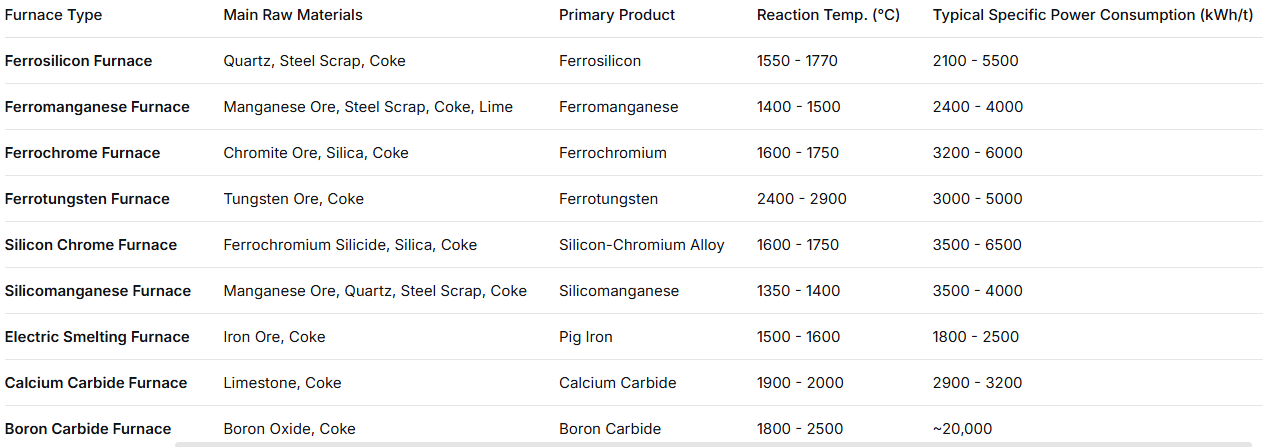
As a high-power, high-current installation, a submerged arc furnace is a complex system. Its major components can be conceptually organized into three functional levels:
Level 1: Furnace Base & Tapping Area
Furnace Body: Includes the foundation, water-cooled or reinforced steel shell, and the refractory lining.
Tapping System: Comprises tap-holes, spouts, ladles, and slag pots, often serviced by a tapping car.
Level 2: Primary Operating & Smelting Zone
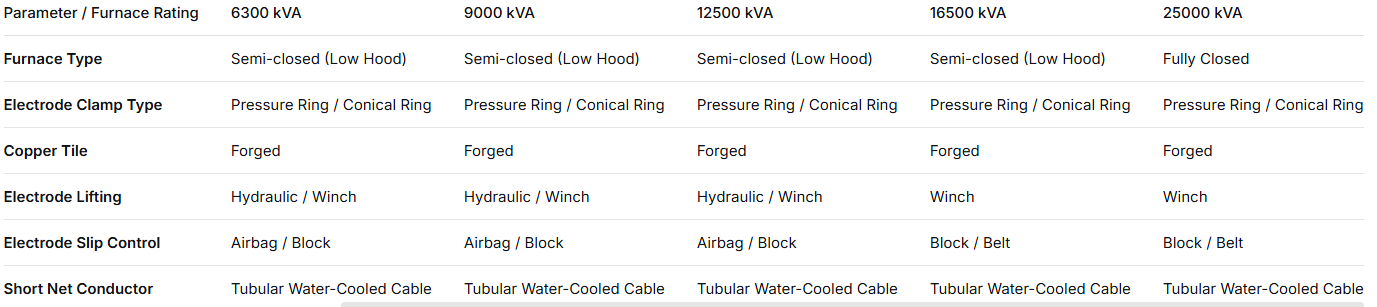
Fume Hood: Modern SAFs typically employ closed or semi-closed (low) hoods. This design is crucial for environmental control, enabling the capture and cleaning of process gases (rich in CO) and facilitating energy recovery. It also reduces heat loss, improves the working environment, and lowers the temperature of the upper electrode system.
Electrode System: Most SAFs use a three-phase AC supply with three electrodes arranged in an equilateral triangle. The system includes:
Electrode Holders & Clamps: Often copper or copper-alloy contact pads ("copper tiles") cooled by water.
Electrode Column: For large furnaces, this is typically a continuous self-baking electrode made from a paste of anthracite, coke, and coal tar pitch, contained within a steel casing.
Short Network (Short Net): The low-voltage, high-current busbar system connecting the transformer to the electrode holders.
Raw Material Handling: Includes the charge feeding system and bin.
Core Support Systems: The furnace transformer, water-cooling system, off-gas system, and the main operational controls.
Level 3: Upper Platform & Ancillary Systems
Electrode Regulation: Comprises the hydraulic (or winch) electrode lifting system and the electrode slip (pressure release) control device.
Raw Material Distribution: The main feed hopper and the circular distribution car (or chutes) for even burdening.
Support Structure: The main operating steel platform.
Additional Systems: May include auxiliary feeding systems (e.g., inclined bridge), automated weighing and batching systems, and comprehensive dust collection.
We are a professional electric furnace manufacturer. For further inquiries, or if you require submerged arc furnaces, electric arc furnaces, ladle refining furnaces, or other melting equipment, please do not hesitate to contact us at susie@aeaxa.com

